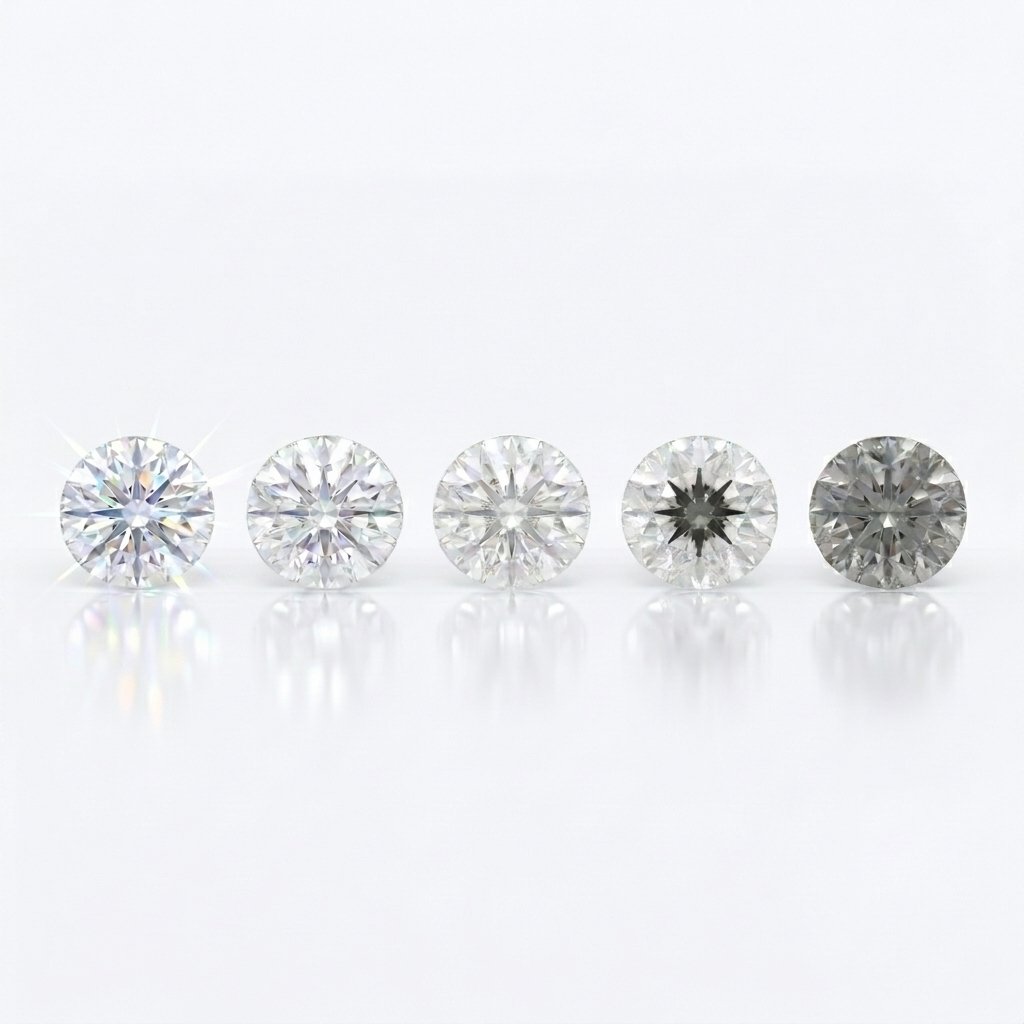
Diamond cut
While the other grading factors focus on nature’s raw contribution, Cut is entirely the work of master artisans. A common misconception is that “cut” refers to a diamond’s geometric outline, such as a round, oval, or emerald shape. In professional gemology, cut quality evaluates how precisely the stone’s angles, proportions, symmetry, and polish interact with light. It is the ultimate measure of human skill applied to a natural treasure.
To achieve maximum light return, every facet must be mathematically optimized.
When a diamond is cut, artisans must balance three critical structural components:
- Proportions: The relationship between the table size, crown angle, pavilion depth, and girdle thickness. If proportions are off, light leaks out through the bottom or sides instead of bouncing back to your eyes.
- Symmetry: The exact alignment and precise placement of all facets. Perfect symmetry ensures that light is distributed evenly across the entire face of the diamond.
- Polish: The smoothness and finish of each individual facet surface. Even microscopic polishing lines can scatter light and diminish the stone’s overall luster.
- Visual Effect
Technical Description
- Brilliance
The total return of white light from both the exterior facets and the internal mirrors of the stone.
- Fire
The splitting of white light into the full spectrum of rainbow colors, creating vibrant flashes when the diamond moves.
- Scintillation
The dramatic pattern of light and dark areas, combined with flashes of sparkle generated by movement.
For standard round brilliant diamonds, laboratories issue a strict performance grade ranging from Excellent to Poor:
- Excellent: Captures and reflects almost all incoming light, displaying unmatched brilliance and fire.
- Very Good: Reflects nearly as much light as an Excellent grade, but at a more accessible price point.
- Good: Offers a balanced sparkle while allowing some light to escape, making it a budget-friendly alternative.
- Fair & Poor: The diamond is cut either too deep (making it look dark in the center) or too shallow (causing a “fisheye” effect where light leaks completely out of the bottom). These stones lack life and vitality.
At Polokokta, we guide our clients with a simple rule: never compromise on the cut. You can easily adjust your expectations on color or clarity grades, but a subpar cut cannot be fixed. An exceptionally cut stone will always outshine a larger or purer diamond that suffers from poor proportions.
The Final Verdict




